Project Description
RAIN (Resilience through Affordable and Inclusive Weather Insurance) is Riwe's flagship climate-finance programme for smallholder farmers, delivered under the Tadamon Accelerator with funding from the United Nations Development Programme (UNDP), the Islamic Development Bank (IsDB) and the Islamic Solidarity Fund for Development (ISFD). It brings parametric crop insurance, agricultural input credit and SMS early-warning alerts to farmers across Benue and Kaduna States — all accessible on a basic mobile phone by dialling *347*820#, with no smartphone or internet required.
THE PROBLEM
Fewer than 3% of Nigeria's roughly 36 million smallholder households have access to any form of agricultural insurance. Traditional crop insurance is built for large commercial farms, inaccessible on feature phones and buried in paperwork, while lenders avoid agricultural credit because climate risk makes repayment uncertain. As a result smallholders — especially women — absorb climate losses personally and farm below capacity, because a downside that cannot be insured is one that has to be avoided.
WHAT THIS PERIOD ESTABLISHED (20 April – 15 September 2026)
RAIN registered and verified 4,005 farmers across Benue and Kaduna, 45% of them women (among farmers who disclosed a gender at registration, roughly a third). 510 parametric insurance policies were sold, 2,193+ agro-weather alerts were delivered by SMS in local languages, and over USD 8,000 in input credit was facilitated. The programme delivered at 99.9% budget utilisation, with all fourteen budget lines within allocation.
USSD DROVE ADOPTION
The USSD platform (*347*820#) was the single largest determinant of adoption. 2,774 farmers (88.2%) registered on USSD versus 370 on the web, at a median registrant age of 33. USSD runs on the signalling channel rather than data, so registrations completed in communities where a web form would simply not load — turning a connectivity constraint into a design advantage. One-time-password verification at each step, which the team had not expected to matter, became the most-praised feature: farmers cited it as evidence the service was legitimate rather than a scam.
BUILT FOR ADOPTION, NOT ATTENDANCE
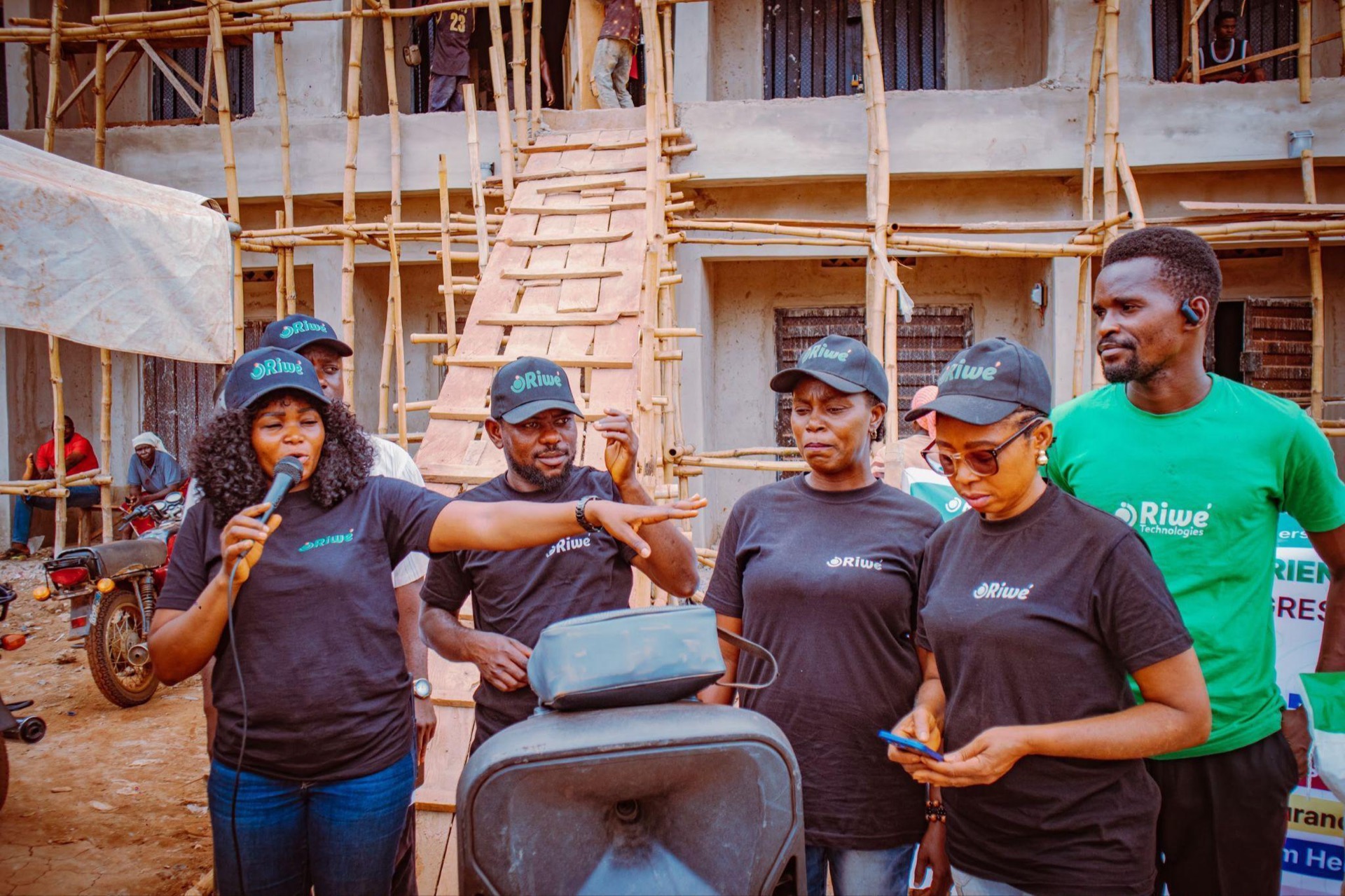
RAIN was run as a customer-acquisition drive, not an aid distribution. Farmers funded their own Ruralpass wallets — typically USD 0.80 to 2.00, small sums and entirely voluntary — the single strongest signal in this report, because enrolment measures reach but payment measures belief. Every farmer who attended a session left with an account rather than a leaflet, and each received a portable Ruralpass identity carrying their farm records, verification status and history.
REGULATORY MILESTONE: THE NAICOM SANDBOX
The outcome with the longest reach was admission into the National Insurance Commission (NAICOM) Regulatory Sandbox. For parametric climate insurance — a product class with no regulatory precedent in Nigeria — the sandbox is the only lawful route from prototype to market. A modest legal-and-regulatory filing produced the admission, which in turn unlocked partnership agreements worth over USD 20,000. Riwe moved from a technology provider adjacent to insurance to a supervised participant with a defined pathway to licensing.
LIVELIHOODS AND CREDIT
Fifteen field agents were recruited from the communities they served and trained across five sessions, earning an average of USD 86 per month — above the national minimum wage. Employment doubled as delivery infrastructure: farmers were onboarded by people they already knew and could find again. Through the micro-loan facility, more than USD 8,000 in inputs — seeds, fertiliser and herbicides — was disbursed directly to approved suppliers rather than as cash, with 65% of recipients having no prior access to formal finance.
IMPACT IN ONE FARMER
Samuel Akaakaa farmed one hectare last season. Through RAIN he accessed input financing, verified his farmland through Ruralpass and took parametric cover. This season he farms 3.1 hectares, with insurance across the full area. Verification made him legible to a lender and insurance made the downside survivable; together they made a threefold expansion a rational decision rather than a reckless one.
SCALE-UP AND REPLICATION
RAIN is built as a replication-ready model. The NAICOM pathway, the public farm-verification tool (riwe.io/verify-farmland), the formalised agent-compensation plan and 510 policies of commercial proof together make the model portable to new geographies. Riwe intends to extend it into additional northern and middle-belt states — starting with Kaduna, Kogi and Benue — funded by a USD 500,000 SAFE raise now underway.
Project financed with the contribution of the Islamic Development Bank (IsDB) and the Islamic Solidarity Fund for Development (ISFD), implemented by UNDP.
Project Locations
Benue State, Nigeria
Kaduna State, Nigeria (5 LGAs)
Aliade, Gwer East LGA
Igbor, Gwer East LGA
Mase, Gwer East LGA
Tyoa-Du, Gboko LGA
Owuleme & Ijami, Ohimini LGA
Iyonum
Makurdi
Key Impact Metrics
4,005 farmers registered and verified across Benue and Kaduna — 45% women
510 parametric crop insurance policies sold
2,193+ agro-weather early-warning alerts delivered by SMS in local languages
88.2% of farmers onboarded via USSD (*347*820#) on basic phones — no internet required
15 field agents employed, earning above the national minimum wage
USD 8,000+ in agricultural input credit facilitated — 65% of recipients had no prior formal finance
Admitted to the NAICOM Regulatory Sandbox — a supervised pathway to licensing
USD 20,000+ in new partnership agreements secured after sandbox admission
99.9% budget utilisation across all 14 budget lines — every line within allocation
Approx. 1.7 million total media, social and advertising reach
Project Partners
UNDP / ISFD — Tadamon Accelerator grant funder
Islamic Development Bank (IsDB)
Leadway Assurance — parametric crop insurance underwriter
Novus Microfinance Bank — micro-loan disbursement
MTN Nigeria — USSD & mobile money (*347*820#)
Food Futures Africa — financial literacy training & co-financing
AATF — climate-resilient Tela maize seeds & farmer training
NAICOM — regulatory sandbox admission
IWP Enterprise — agricultural input supply
Dybam Jkass Global — local input vendor
Project Details
- Status
- In Progress
- Duration
- Apr 2026 - Sep 2026
- Region
- 🇳🇬 Benue & Kaduna, Nigeria
- Completion
- 90%
